DIETETICS= The science of diet & nutrition & it's application to health and disease. DEGUSTATION= To taste and savour an array of small dishes using all the senses.
Saturday, 30 May 2015
It's not all about the kilojoules!
I love cooking. And I love nutrition. So naturally I tend to adapt the recipes I cook to make them more nutritious. But let me let you in on a little secret: it's not all about the kilojoules! Whilst many of my typical adaptations (e.g. adding more veg) tend to reduce the overall kilojoule (or calorie) content of the meal, this is more of a by-product than the aim.
I think there has been a shift in the nutrition world recently toward adding more healthy fats, protein and fibre into 'healthy' meals, rather than taking things away (like carbs or fat). And this is often something I focused on when I worked in private practice- telling people what they could eat more of, not what they should eat less of. Because when you add those good things in there's less room for the other stuff (like stodgy carbs, fried meats and salty sauces).
I hope the days of kilojoule (or calorie) counting are long gone, because, while I agree that it's important to have an understanding of how some foods provide you with more energy than others on a basic level, I think it can often turn into an obsession which completely misses the point. The point being that food is there to provide nourishment, to fuel your body but also provide satisfaction and enjoyment.
I know I certainly wouldn't enjoy a low-cal meal such as plain lettuce and grilled chicken! I'd need to add more veg for flavour, marinate the chicken or rub it with garlic or spices, add a grain like brown rice or quinoa and dress it with an extra virgin olive oil based dressing and maybe some avocado or roasted nuts. Yes, it wouldn't exactly be low-cal anymore, but it would be tasty, filling and provide me with a large range of vitamins and minerals that comes from having a varied diet. Plus, I don't know about you, but if I restricted myself to plain lettuce and chicken for dinner I'd be raiding the cupboards for something else and it would likely end up blowing that one (unenjoyable) low-cal meal right out anyway!
So, be aware of what kilojoules are, but don't get bogged down in the numbers. Instead, focus on providing your body with the nutrients it needs.
Tuesday, 12 May 2015
Healthy fried rice
Ahh fried rice. The dish everyone gets Chinese takeaway for, right? Well, despite the 'fried' in the title, it doesn't have to be unhealthy and can certainly make for a balanced mid-week meal. How you ask? Well, by a few simple swaps:
- White rice for brown rice (using the microwave version makes it even faster)
- Bacon for lean ham
- Regular soy sauce for reduced salt soy sauce
- Excess vegetable oil for a smaller amount of olive oil
- Extra veg!
Quick and healthy fried rice
2 C cooked brown rice
4 eggs, lightly beaten
8 thin slices lean ham, diced
2 Tbsp reduced salt soy sauce
1 tsp minced ginger
1 tsp minced garlic
1 brown onion, finely diced (or 1/2 bunch spring onions, white parts sautéed at start and green parts added to garnish at the end)
4 C finely chopped vegetables (I used beans, carrots and mushrooms, but you could also add peas, broccoli, zucchini, capsicum, etc)
- Pour beaten egg into a large frypan sprayed with a little olive oil and spread out to form a thin omelette. Cook over a medium heat until cooked through, flipping once. Remove from pan and cover with foil to keep warm.
- Saute onion in the same pan with another spray of olive oil until translucent. Add garlic, ginger and ham and cook, stirring for 1 minute. Add vegetables and cook over medium heat until just soft.
- Add cooked rice and soy sauce to pan, stirring until mixed well. Divide among 4 bowls.
- Meanwhile, roll omelette and slice into 1cm thick scrolls. Place 1/4 of the egg scrolls onto each bowl of fried rice.
Serves 4
Monday, 4 May 2015
How 3 popular protein bars stack up
Protein bars. The food alternative to protein shakes designed to help you gain muscle post resistance exercise. They aren't new, but they have cemented themselves into the health food aisle of supermarkets and chemists, not to mention gyms and health food stores. I decided it was high time I reviewed them, considering the ongoing popularity of my post 'lifting the lid on protein powder' last year.
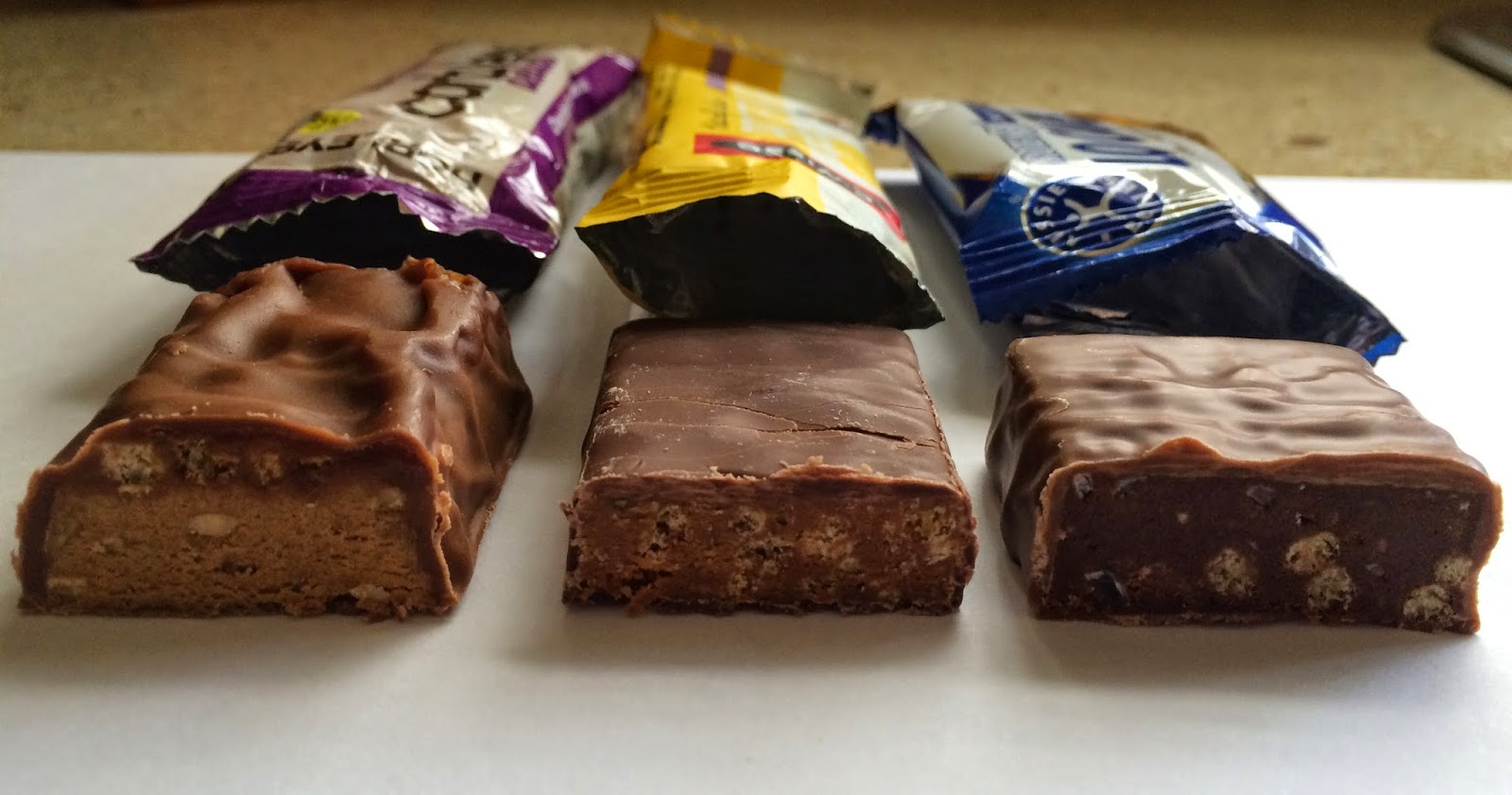
Here I've picked three popular protein bars and compared them based on taste and nutrition.
What's actually in protein bars?
Protein bars come in many flavours but it's usually based around chocolate. The first ingredient in all three bars I looked at is protein blend at 30-40%. This is basically the protein 'powder' you can buy to turn into shakes. This is then followed by a long list of ingredients, many of which are long and difficult to pronounce (like polyglycerol esters of interesterified ricinoleic acid- um, what?). Chiefly, it's a mix of sugar (in it's many forms), chocolate, vegetable oil and additives like emulsifiers and flavours.
Protein comparison
Aussie Bodies Protein FX Lo Carb Mini Protein Bar (Choc Honeycomb)
9g protein/30g serve or 29.9g/100g
Swisse Low Carb Protein Bar (Choc/Caramel Flavour)
9.5g protein/25g serve or 37.9g/100g
Horleys Carb Less Deluxe (Chocolate Peanut Flavour)
10.1g protein/35g serve or 28.9g/100g
So, despite the Swisse bar coming out on top for protein per 100g, they are all roughly the same per serve. The bar sizes do vary, but lets face it: you're going to eat the amount that's in the packet, not leave a bite.
How do protein bars stack up against other protein containing foods?
- 1 chicken breast= 53.4g protein or 31g/100g
- 2 hard-boiled eggs= 11g protein or 12.4g/100g
- 250mL glass reduced fat milk= 10g protein or 4g/100mL
- 30g (small handful) mixed dry roasted nuts= 5.2g or 17.3g/100g
That means you could get the same amount of protein from a glass on milk, 2 hard-boiled eggs or 2 small handfuls of nuts. And meat is just off the scale…
Aussie Bodies Protein FX Lo Carb Mini Protein Bar (Choc Honeycomb)
A nice sweet flavour and very chewy. But still quite dry and with a powdery aftertaste.
Swisse Low Carb Protein Bar (Choc/Caramel Flavour)
Hard, dry and powdery plus a lack of flavour. Choc caramel: who knew? Definitely the worst.
Horleys Carb Less Deluxe (Chocolate Peanut Flavour)
A chewy centre, made softer by a layer of caramel. Nice flavour without the powdery texture of the other three. Could be mistaken for a chocolate bar but the clear winner in taste.
The verdict
Protein bars can be a convenient snack post work out, but they're also highly processed and expensive. With many everyday foods providing the same (if not more) protein per serve, like milk, eggs and nuts, I think there are much more nutritious options than these chocolate bars marketed under the guise of health. If you do choose a protein bar, I'd recommend combining it with a carbohydrate containing snack for the right muscle-building fuel. And choose well as some certainly taste better than others!
A nice sweet flavour and very chewy. But still quite dry and with a powdery aftertaste.
Swisse Low Carb Protein Bar (Choc/Caramel Flavour)
Hard, dry and powdery plus a lack of flavour. Choc caramel: who knew? Definitely the worst.
Horleys Carb Less Deluxe (Chocolate Peanut Flavour)
A chewy centre, made softer by a layer of caramel. Nice flavour without the powdery texture of the other three. Could be mistaken for a chocolate bar but the clear winner in taste.
The verdict
Protein bars can be a convenient snack post work out, but they're also highly processed and expensive. With many everyday foods providing the same (if not more) protein per serve, like milk, eggs and nuts, I think there are much more nutritious options than these chocolate bars marketed under the guise of health. If you do choose a protein bar, I'd recommend combining it with a carbohydrate containing snack for the right muscle-building fuel. And choose well as some certainly taste better than others!
Saturday, 25 April 2015
Baked apples with an oaty crumble stuffing
It's getting to that time of year again where I crave warming wholesome desserts. And while traditional apple crumble may be a little heavy handed on the sugar and butter and a little lacking on the apples, these baked apple crumbles are anything but. Individual half apples, baked, with an oat and almond crumble filling piled high and served with my low sugar creamy vanilla custard (see my profiterole post for the recipe), these are full of fibre and protein and are 1/2 a serve of fruit each.
Note: you can prepare the crumble filling ahead of time, but once baked, these are best eaten straight out of the oven!
Baked apples with an oaty crumble stuffing
3 green or red apples, halved horizontally
with the core scooped out
Juice of 2 lemons
¾ C rolled oats
½ C almond meal
¼ C plain wholemeal flour
1 Tbsp brown sugar
1 Tbsp linseeds
1 heaped Tbsp chopped almonds
1 tsp cinnamon
3 Tbsp butter/margarine
- Preheat oven to 180°C.
- Drizzle cut apple surfaces with lemon juice to prevent them turning brown. Place into a baking dish with 2cm of water and set aside.
- Combine oats, almond meal, wholemeal flour, brown sugar, linseeds, chopped almonds and cinnamon in a medium bowl. Add butter/margarine and rub with your fingertips to form a crumble.
- Divide crumble mixture amongst apple halves, spooning into hole and piling up on top. You may have to press the mixture down so it all fits and doesn’t just fall off.
- Bake apples for 30 minutes or until apples are soft and crumble is golden brown.
- Serve with custard or ice-cream.
Serves 6.
Sunday, 19 April 2015
Product Review: Oats + Chia Apple Spice
We're heading into the cooler months, when porridge sales increase 10-fold (I'm just making that up, but surely it's a lot right?). And when you decide it's time to make the warming switch, there'll be one extra brand to choose from. The Chia Co are now making oats! Plus chia of course…
I decided to put it to the test on a recent overnight work trip, and there were 3 main things I was looking for: convenience, nutrition and (most importantly) taste! So how did it fare?
Convenience
Oats + Chia come in a small foil-lined sachet with instructions to either add cold water and microwave or add boiling water and let sit for a minute (literally one). Being that I was in a hotel room with no microwave and only a kettle, I went for the second option. And it worked really well! I poured the Oats + Chia into a mug, added the boiling water, waited and stirred. Super quick and simple and perfect for travel times like these (or early morning dashes out the door!).
One drawback? The price. A pack of five will set you back $7.30 compared to a 12-pack of Uncle Toby's quick oat sachets for just $4.00. A lot of this will be due to expensive ingredients though, including the chia and coconut oil.
Nutrition
Chia + Oats contain maple sugar, dried apple, virgin coconut oil and spices along with the main stars oats and chia seeds. Now, while I can applaud the short (and identifiable) ingredients list, I'm not sure why you'd need coconut oil (or any type of fat for that matter) in a porridge? It doesn't have a manufacturing purpose that I'm aware of, and I certainly couldn't taste it, but it does significantly add to the saturated fat content.
On the plus side, this new porridge is a great source of fibre (6.1g or 25% of your RDI per serve), has a reasonable sugar content (given it is 10% apple) and some omega-3 ALA (from the chia). But I'd probably want to have it with some yoghurt or milk for a bit of calcium and extra protein to balance it out for brekky.
Taste
I sampled the apple spice flavour, which certainly lived up to its name. There was plenty of nice large apple pieces and lots of spice! While a combination of cinnamon, ginger and nutmeg, the main standout flavour was the ginger. A bit different to the standard apple cinnamon flavours you normally see, but I couldn't help but feel like I was eating a ginger nut biscuit in porridge form!
The final word?
Not a bad option when it comes to quick and satisfying winter breakfasts and certainly flavoursome, but I'd probably save the sachets for work trips and stick to my own home made version of oats and chia porridge on a day-to-day basis to save some dough and cut the oil.
Thursday, 9 April 2015
Ginger-lime chicken lettuce wraps with coconut rice noodles
When I was in Hawaii earlier this year I had this great meal. So fresh, so light, and so flavoursome! It was like a version of tacos (just as messy too!) but using Asian inspired flavours: ginger, lime, chilli and coconut. And of course I had to recreate it.
Rice noodles are great because they cook quickly, but they also take on whatever flavour you cook them in, which is why cooking them in coconut milk really gave them a life of their own. I served these with the chicken and rice noodles hot, which is a good contrast to the cold bean sprouts, carrot and of course lettuce! The dipping sauce adds some spice and is based on a Donna Hay dipping sauce recipe (but with a lot less sugar!). Enjoy sharing this one for your next family meal...
Ginger-lime chicken lettuce wraps with coconut rice noodles
1 cos lettuce, leaves rinsed and separated
125g rice noodles
375g tin coconut milk or coconut flavoured
evaporated milk
1 C water
2 chicken breasts, cut in half horizontally
2 tsp minced ginger
2 tsp minced garlic
Juice of 1 lime
2 large handfuls bean sprouts
2 medium carrots, grated or finely sliced
Chilli
and ginger dipping sauce:
1 thumb-sized piece of ginger, peeled and
shredded
1 long red chilli, deseeded and shredded
1 Tbsp fish sauce
2 Tbsp castor sugar
1/3 C water
- Combine minced ginger, garlic and lime juice in a large non-metallic bowl. Add chicken breasts and toss to coat. Cover with cling film and put in the fridge to marinate for 2-3 hours.
- Make dipping sauce: add all ingredients into a small saucepan and place over medium heat, stirring, for 3-5 minutes, until sugar is dissolved and the flavour of the chilli and ginger permeates through the sauce. Refrigerate until needed.
- Cook chicken in a large frypan over medium-high heat until golden brown and cooked through. Remove from pan and slice into thin strips.
- Meanwhile, heat coconut milk and water in a medium saucepan until just boiled, add rice noodles and reduce to a simmer for 5 minutes or until noodles are cooked. Drain.
- Serve lettuce leaves with grated carrot, bean sprouts, coconut rice noodles and marinated chicken, to roll into wraps and dip into dipping sauce.
Serves 4 (3-4 'wraps' each).
Friday, 27 March 2015
Sugar: the missing (label) link
I have this pet peeve about sugar and it's drawn attention to every time I look at the Nutrition Information Panel (NIP) on the back of a food label (which is relatively often considering I'm a Dietitian and like knowing what's in my food). And it's not what's there that bothers me, but rather what ISN'T there: a row under total sugars labelled 'added sugar'.
Why does this bother me so much? Maybe because there's a big difference between sugars naturally occurring in the food to those added by man to sweeten a product. And yes, this problem could be solved by simply avoiding all packaged and processed foods, which is certainly a good aim to have, but isn't all that realistic for the average person.
Consider the amount of sugar in a bowl of natural muesli (21%) versus a chocolate chip muesli bar (also 21%). While they may have the same amount of sugars (total) they certainly aren't comparable nutritionally. And that's because the sweetness in the muesli is coming from sugars naturally occurring in the dried fruit, while the muesli bar contains added sugar in both the choc chips and the bar itself
So be mindful when looking at labels that you make a mental note to differentiate between natural and added sugars by looking at the ingredients list. If the product contains a large proportion of fruit, milk or yoghurt then those products may have a higher content of sugars due to those naturally occurring in the fruit or dairy. But if sugar (or brown rice or malt syrup, honey, agave, molasses, dextran, glucose or invert sugar, or any other of sugars aliases) is listed on the label, particularly in the first few ingredients as they are listed in order of amount, then it's safe to say that product contains too much (added) sugar.
To find out more about reading labels, check out my post Nutrition Information Panels: Decoded.
Subscribe to:
Posts (Atom)