Saturday, 16 August 2014

5 nutrient interactions you should know about!


We are told to eat a balanced diet because every food contains a different combination of nutrients. But did you know that some of these nutrients interact with each other in our bodies and can increase or decrease the absorption of other nutrients? I've put together a list of the 5 nutrient interactions you should know about, including whether (or not) this should change the way you eat!

Iron & Vitamin C


Vitamin C can enhance the absorption of iron by up to 50% by helping convert the iron consumed into a form more easily absorbed by the body.
  • Eat iron-rich foods (such as meat or iron-fortified cereals) with vitamin C-rich foods (such as red capsicum and citrus fruits).
Tip: Add some red capsicum to your beef stir-fry or a sliced orange or kiwifruit with your cereal at breakfast.


Calcium & Vitamin D


Vitamin D enhances calcium absorption by stimulating it’s transport throughout the body.
  • The best source of vitamin D is sunlight- so make sure if you’re eating enough dairy you’re also getting some time outdoors.
  • Also, if your doctor or dietitian has recommended a calcium supplement, choose one that contains both calcium and vitamin D.


Iron & Phenolic Compounds


Phenolic compounds in tea can bind to iron, inhibiting its absorption in the body.
  • Avoid drinking tea with meals as it can reduce the amount of iron you’ll absorb from it.
Tip: Try having your tea mid-morning rather than with breakfast


Fibre & Many Minerals


Phytic acids (such as oxalic acid) in high fibre foods such as fruits, vegetables and wholegrain breads and cereals can bind minerals such as iron, calcium, zinc & magnesium, inhibiting their absorption.
  • Yeast in leavened bread can counteract this (by breaking down some of these bonds allowing the minerals to be absorbed).
  • Diets excessive in fibre are not recommended- but most Aussies are having trouble even meeting the recommendations.
Tip: Stick to 5 serves of veg, 2 serves of fruit and 5 serves of whole grains.


Different Mineral Supplements


Many minerals compete for absorption in the body: magnesium, calcium, iron, copper and zinc. This can especially be a problem if you are taking any supplements of these nutrients because supplements often contain many times the recommended intake of that nutrient from food. For example, if you are taking a calcium supplement, it could be inhibiting iron absorption from the food you eat.
  • Most people, if they are eating a balanced and varied diet, are getting all the nutrients they need and don’t need supplements. 
Tip: Avoid supplements unless actually necessary. Unsure? Ask your doctor or dietitian if you need one.

Saturday, 9 August 2014

Homemade Dumplings


I have this list of things I want to cook. Not simple, everyday recipes, but those which would give me joy to master (yes, I am aware this quite possibly sounds very lame to those of you who aren't as addicted to cooking as I am!). And so came about: dumpling day. My boyfriend and I bought the ingredients, watched youtube clips of how to form the dumpling 'pleats' (the folding pattern you use to seal the dumplings) and he panicked while, instead of following a recipe, I just made it all up as I went along! Then we sat and marvelled at the fact we had just made our very own dumplings (while shoving them in our gobs). This recipe is the result. I hope you enjoy them as much as we did!

If you don't need 45 dumplings, simply halve the recipe. You can also choose to just make the vegetable or chicken dumplings (to make the chicken dumplings without the vegetable mix, just add 1/4 C of mixed shredded cabbage and carrot, with some of the garlic, ginger and soy sauce.

Homemade dumplings

45 gow gee wrappers (found in the fridge section of the supermarket)
1 egg, lightly beaten

Vegetable Filling
1/8 cabbage (or ¼ Chinese wombok), finely shredded
½ large carrot, finely grated
2 spring onions, finely diced
150g tinned bamboo shoots, finely diced (found in the Asian section of the supermarket)
½ tsp minced garlic
½ tsp minced ginger
1 tsp sesame oil
1 Tbsp reduced salt soy sauce
1 Tbsp dry sherry (or Chinese rice wine)
Optional: replace half of the vegetables with silken tofu for more protein

Chicken Filling
150g lean chicken mince
1 Tbsp chives, chopped
¼ C ‘vegetable filling’ mix

Dipping sauce
¼ C reduced salt soy sauce
2 Tbsp dry sherry (or Chinese rice wine)
1 tsp sesame oil
2 tsp castor sugar
1 tsp minced ginger
¼ tsp Chinese five spice
½-1 tsp minced chilli, or fresh chilli sliced
1 tsp sesame seeds

      1. Cook vegetable filling in a large frypan over low-medium heat until veg is softened and liquid evaporated. Remove from heat and allow to cool slightly. Transfer to a bowl.
2. Mix ¼ C of the ‘vegetable filling’ into the chicken mince and chives, in a separate bowl.
3. Divide beaten egg among both fillings (about 2/3 of the egg in with the vegetable mix and 1/3 in with the chicken mix) and stir to combine.


 4. Place 1 gow gee wrapper on the bench in front of you. Have the bowls of filling sitting close by, along with a small bowl or cup of water. Place 2 tsp of chicken or vegetable filling in the centre of the wrapper and, with your finger, trace a circle of water along the border of the wrapper (you only want enough water to stick the edges of the wrapper together, if it is too wet it will not stick).


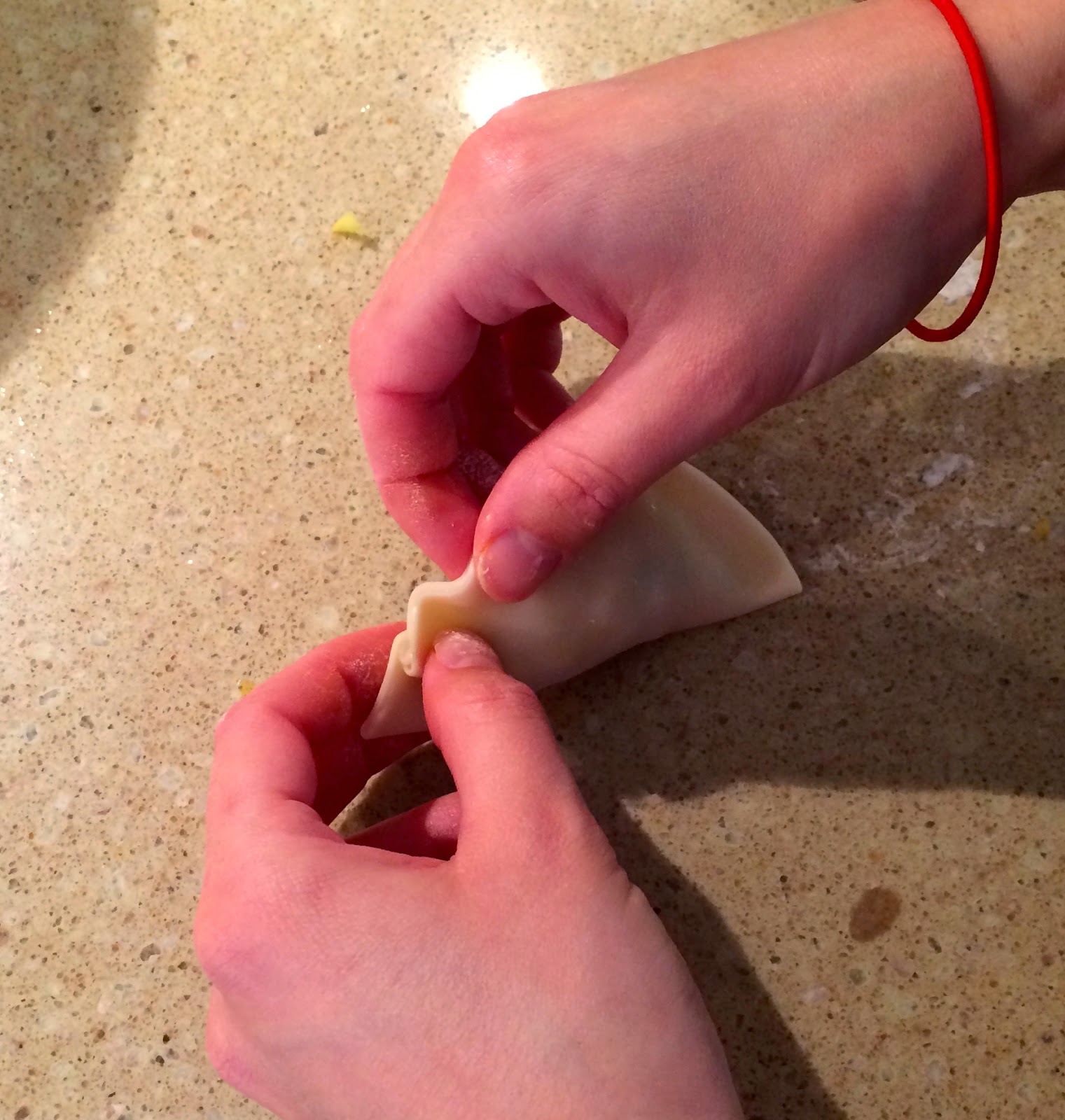
5. Fold wrapper in half to form a semi-circle, pressing the opposite edges of the wrapper together. 


      6. Carefully fold over the edges of the wrapper to form pleats. Repeat with remaining wrappers and filling mixtures.


7. Meanwhile, bring a medium saucepan of water to the boil. Line each level of a bamboo steamer basket with baking paper, place ~6 dumplings on each level (try not to let them touch as they will stick together when cooking), assemble steamer basket with lid on top and place over the boiling water. The steamer basket should sit neatly on top of the saucepan so that no steam is escaping and make sure the saucepan isn’t too full with water as you want to avoid the boiling water touching the base of the steamer basket.
8. Steam for ~15mins, then repeat steaming process until all dumplings are cooked.


9. Meanwhile, make dipping sauce: toast sesame seeds in a small saucepan over medium heat. Add remaining ingredients and simmer for 3-5mins or until slightly thickened and sugar is dissolved. Cool before serving.


      Serves 7-8 (~6 dumplings per serve)

      Note: Leftover dumplings can be refrigerated and reheated at a later stage by steaming in the microwave in a covered bowl or container, with a small amount of water. 


Saturday, 2 August 2014

Coping with snack cravings: How to trick your tastebuds into satisfying that craving without blowing the energy budget


We've all felt the tug of a craving from that irresistible snack. "Just one", you tell yourself; "I've had a rough day- I need a pick-me-up", your emotions beckon, or; "but I've eaten so healthily all day!". We try to rationalise our cravings, but the truth is, there just really is no good reason to devour an entire block of chocolate or crunch through a whole bag of chips. But that doesn't make it any less difficult to stop ourselves when those thoughts sneak into our heads!

When it comes to weight loss, or following any kind of healthy eating habits, really, the difficult part is convincing your brain that it DOESN'T need another can of soft drink or handful of sticky, coated beer nuts. Because brains are powerful things. And willpower actually requires both will and power (who'd have thought?).

As a Dietitian, I always talk about eating in moderation. I would never tell anyone they must give up all of their treat foods, because a) that is not very realistic and b) who wants to live life without ever having a piece of birthday cake? Certainly not me. And, I mean, who is really going to be satisfied with a handful of nuts or a piece of fruit when it's chocolate they're craving? It's more about enjoying your favourite foods in smaller amounts and less often (hence the premise of 'treat'). But sometimes it isn't as easy as that. A lot of my clients tell me they'd rather cut it out altogether as they can't stop at one. So, for those of you who struggle with moderation, here are my top tips for coping with snack cravings, plus some snack alternatives to satisfy what you're really craving (salty? creamy? chocolatey?) without the guilt!

Jessie couldn't decide whether she felt like
salty, sweet, or both!
My top tips for coping with snack cravings:
  • Set mini goals for yourself, such as cutting back on having soft drink twice per day to once per day, then once every two days, etc.
  • Store ‘treat’ foods in an opaque container at the back of the pantry (out of sight, out of mind).
  • Make a decision to only buy your craved food once a month so it becomes a sometimes food. Or, if it works better for you, avoid buying it altogether and only eat it when out for a special occasion.
  • Have a drink, chew some gum, go for a walk, or make a phone call before committing to satisfying your craving. It will often go away if your mind is occupied with something else.
  • Practice mindful eating- eat slowly and savour your food and you’ll find you are satisfied with less.
  • Never sit down with a whole packet of biscuits or block of chocolate. Portion out a serve, and then put the packet away.
  •  If you’re a late night snacker, make it a habit that you don’t eat after 8pm, for example, and signal the end of food by brushing your teeth.

When you're resorting to the cooking chocolate,
you know times are desperate!

      Craving something sweet?
      Try: 1 slice wholegrain raisin toast (e.g. Burgen fruit & muesli bread) with a thin spread of table spread or small fruit based muffin made with wholemeal flour and added seeds

Craving something salty?
Try: 1 piece rye mountain bread or ½ cup thinly sliced potato, sweet potato, parsnip, carrot or beetroot, sprayed with a little olive oil and sprinkled with garlic and oregano, cut into squares and baked in the oven or 2 wholegrain crackers (such as Vita-Weats) topped with 1 slice of reduced fat cheddar cheese and ½ tomato, sliced

Craving something crunchy?
Try: 2 cups air-popped popcorn plain or sprinkled with Mexican chilli powder or 1 handful of bite-sized wholegrain crackers (such as Tucker’s Multifibre Snacks Quinoa) plain or dipped into a tomato salsa

Craving something chocolatey?
Try: 1 small glass of skim milk with 2 tsp drinking chocolate (such as Milo or Vitarium sugar-free) or 2 chocolate date balls made by processing dates, cocoa powder, LSA or almond meal, coconut and chopped nuts and coating in more cocoa powder

Craving something nutty?
Try: ½ sliced apple spread with 1 Tbsp natural (no added salt or sugar) peanut (or other nut) butter or 1 small handful trail mix made of raw unsalted mixed nuts, dried fruit and seeds

Craving something creamy?
Try: 100g reduced fat ricotta (sweetened with vanilla, cinnamon and a little icing sugar) with ½ punnet of strawberries or 200g tub reduced fat natural or Greek yoghurt (e.g. Yoplait Forme Greek)

Craving something refreshing?
Try: 1 glass of ice cold still or sparkling water with a slice of lemon and few leaves of mint or ¾ cup frozen grapes 

Craving something warm & comforting?
Try: 1 sachet plain quick oats with ½ a grated apple and ½ tsp cinnamon or 1 cup vegetable soup (e.g. Heinz classic creamy pumpkin) 

Saturday, 26 July 2014

Recipe makeover: Pumpkin Pie


The all-American pumpkin pie is a thanksgiving tradition. And while it's not really a 'thing' here in Aus, I was curious to see what a sweet pie made from a vegetable could taste like… Not that it's anything new- teaming vegetables with dessert- just think how delicious carrot cake is! I mean, it has the potential to be healthy AND delicious! But most classic pumpkin pie recipes are overloaded with cream, butter and sugar, defeating the goodness of the pumpkin. So here is my (healthy AND delicious) version of pumpkin pie :)

Notes: This recipe makes enough pumpkin filling for 1 large pie and 4 individual pies. You can cook the pumpkin in any way you like (boil, steam, roast) but roasting is the method I use here because it brings out the sweetness of the pumpkin a lot better. Despite mashing the pumpkin, the filling will still contain some small lumps of pumpkin- to get it completely smooth you will have to mash then strain the pumpkin before mixing with the other ingredients.


Pumpkin Pie

Pastry:
1 C wholemeal flour
½ tsp baking powder
1 ½ tsp castor sugar
4.5 Tbsp margarine, softened
4.5 Tbsp oil (e.g. macadamia, olive or canola)
6.5 Tbsp ice cold water

Filling:
~800g pumpkin (butternut or kent)- enough to make 2 C mashed pumpkin
185mL can Carnation Light and Creamy Evaporated Milk
2 eggs
½ C brown sugar
1 tsp vanilla
1 tsp cinnamon
½ tsp nutmeg
½ tsp allspice
¼ tsp ground ginger
¼ tsp ground cloves

Optional: Decorate with pecans before baking

      1. Roast pumpkin in large chunks with the skin on at 200°C for ~45mins or until a knife cuts through easily. Set aside to cool.
2. Make pastry: Rub dry pastry ingredients and margarine until crumbly. Add oil, and then water a bit at a time, mixing lightly by hand until pastry stays together when rolled into a ball.
3. Roll out 2/3 of the pastry between 2 pieces of wax/baking paper until large enough to hang over the edges of a 20-22cm (8-9inch) pie or flan dish- this will become the base for the large pie. The pastry should be no thicker than 0.5cm.


     4. Place pastry gently over pie dish that has its base lined with baking paper and the sides sprayed lightly with oil and press to hold. Let the pastry come up above the side of the pie and neaten edge with a knife. Prick the base of the pie with a fork.
5. Repeat with remaining pastry, rolling out over one smaller pie dish or 4 individual tart dishes (I used egg rings, sprayed with a little oil, for mine).


6. Bake pies at 220
°C for 5-10mins or until just cooked and lightly brown. Remove from oven and set aside to cool.
7. Meanwhile, remove skin from roasted pumpkin and mash until smooth. Whisk in remaining filling ingredients and pour into pastry cases.
8. Bake large pie at 180°C for ~40mins and individual tarts for 15-20mins, until filling is set. Remove from oven and allow to cool.
9. Serve at room temperature with reduced fat and sugar vanilla yoghurt or ice cream and store remainder in fridge.


Makes 1 large pie and 4 individual tarts.

Saturday, 19 July 2014

Organic food: to buy or not to buy?


It’s the quandary facing many health-conscious people in our modern world: to buy organic, or not to buy organic. Is it healthier for us? Better for the environment? More flavoursome? Working as a Dietitian, I often get asked by clients whether they should be eating organic food. But the answer isn’t really a simple yes or no…

What does ‘organic’ mean?

‘Organic’ commonly refers to produce (such as fruit, vegetables and grains) that has been grown without the use of synthetic chemicals such as pesticides or artificial fertilisers. Organic meat usually means the animals are free range and not fed any growth-affecting drugs. But organic doesn’t necessarily equate to completely chemical free crops, as they may be grown on land that was previously used for non-organic farming or might have been cross-contaminated from nearby non-organic crops that are being sprayed. Organic meat and produce is often more expensive because the farming generally operates on a smaller scale, is more labour intensive and produces smaller yields.

What’s so good about organic food?

The real benefit of organic farming is environmental. Without the use of harsh pesticides and fertilisers, the soil is at less risk of being damaged or nutritionally depleted than in conventional methods, making the land go further and it more ecologically sustainable.

But the main reason people buy organic? There’s a perception that organic food is healthier. And while organic produce does contain lower levels of pesticide residues (which I might add are also monitored in non-organic foods to ensure consumer health and safety), scientific opinion is divided on whether this impacts nutrient levels in the food. Up until recently, most studies have concluded that there is insufficient evidence to show that organic food has higher levels of nutrients (see here and here) but one new meta-analysis has found higher levels of some antioxidants in organic food (see here). Is this it then? Conclusive evidence that organic food is more nutritious? Not quite. There are many things that impact a foods nutritional quality, other than the use of pesticides: length of time from paddock to plate, storage of the produce during its travel, exposure to light and heat, etc, etc.


How can we ensure the food we buy IS actually organic?


Due to the increasing demand, we are not only seeing local organic fruit and veg, but also imported organic produce and even packaged foods labelled as using organic ingredients.

But the standards that govern organic practices are voluntary and the word ‘organic’ is not regulated in Australia (theoretically meaning anyone can whack it on a label). Domestically marketed organic products are commonly certified by seven organisations classified by the Department of Agriculture, Fisheries and Forestry (DAFF). So make sure you are buying certified organic!

In summary?

Pros of buying organic:
  • Lower pesticide residues & chemical use
  • More environmentally friendly and sustainable
  • Humane treatment of animals in meat farming

 Cons of buying organic:
  • More expensive
  • No significant difference in most nutrient levels (perhaps with the exception of some antioxidants)
  • No strict regulation of organic labelling so you may be thinking you’re buying organic but you actually aren’t


The verdict

Ultimately it comes down to personal choice. If you can afford to buy organic produce, then certainly, go ahead. There are obvious environmental benefits. But stick with fresh local produce and avoid commercial packaged foods that claim to be organic- the processing really defeats the purpose in my book. However, I would not be telling my clients that they all must buy organic because it is not financially viable for everyone to do so and I’d rather they were regularly consuming adequate amounts of fruit, veg, grains and meat, than small amounts of organic food.

My takeaway tip

If it’s your health you’re worried about, try instead to buy fresh, local produce to reduce the distance your food is travelling (and support local farmers) and ensure it is of high nutritional quality. 


Saturday, 12 July 2014

Spicy tomato & bean baked eggs


 This is a popular dish based on eggs baked into a rich tomato sauce. Here I cooked fresh tomatoes down with red capsicum, red kidney beans and a whole heap of Mexican chilli powder, cracked an egg in the centre, topped with cheese and baked in the oven. It's a deliciously warming winter brunch or easy and light dinner.

I made the recipe serve 2 by using a small tin of red kidney beans but if you want to feed the family use a 400g can of red kidney beans and 2x400g cans of diced tomatoes instead of fresh (no-added salt versions of course!). Serve with a piece of toast and dip away…

Spicy tomato & bean baked eggs
*Mexican chilli powder is a spice mix of
paprika, chilli, cumin, oregano, pepper
& garlic. I used Masterfoods Mexican
Chilli Powder Medium.

1/4 large brown onion, diced
1/2 large red capsicum, roughly chopped
3 large tomatoes, roughly chopped
125g can no-added-salt red kidney beans, drained and rinsed
1 tsp minced garlic
Minced or fresh chilli, optional, amount to your liking (I used 1/2 tsp minced)
1/2 Tbsp Mexican chilli powder*
2 eggs
2 Tbsp grated parmesan
Parsley, chopped, to garnish
2 slices wholegrain bread

  1. Saute onion in a small saucepan over low-medium heat until the onion is translucent. Add garlic, chilli and Mexican chilli powder.
  2. Add capsicum and cook until just tender. Add tomatoes and red kidney beans and simmer for at least 15 minutes.
  3. Divide mixture among 2 individual oven-proof dishes (such as 2-cup capacity ramekins). Make a well in the centres and crack an egg into each. Top with parmesan.
  4. Bake at 200°C for around 10 minutes or until eggs are just set. 
  5. Sprinkle with chopped parsley and serve with wholegrain toast.

Serves 2.


Sunday, 6 July 2014

Your guide to eating out (with all of the enjoyment and none of the guilt!)


Eating out can easily become your undoing when trying to lose weight or just eat healthily. Why? Because you get surrounded by delicious sights and smells and you tell yourself you MUST have all three courses AND finish each plate because, well, it would be a waste not to get your money's worth. But a few changed perceptions and a few different menu choices and eating out doesn't have to result in food comas, diet guilt or dwindling funds.


Problem 1: It all tastes so delicious so I can't help but keep eating.

Solution: Practice the art of mindful eating. Eat slowly and savour each bite of food. Put your knife and fork down between mouthfuls and take time to talk to your table guests. You'll find you'll  be satisfied with a smaller portion. Can't decide what to order? Order a few dishes amongst the table and share them- that way you'll get a taste of everything.


Problem 2: I cannot go to a restaurant without ordering dessert: it's my favourite part!

Solution: There's no need to go without dessert, especially if this is the part of the meal you most look forward to. But why not skip the main and go for an entree and dessert instead? Or share a main with a friend then both enjoy dessert? Another option? Choose a lighter, fruit-based dessert and hold the extra cream.

Problem 3: The meal was so expensive, I can't bear to see food go to waste.

Solution: There's no need for the food to go to waste, most restaurants will happily bag up your leftovers in a doggy bag for you to take home and enjoy the next day. You can also check with the waiter or waitress the size of the meal before you order it so you'll have an idea of whether it will be big enough to share (which also means a shared cost).


Problem 4: I'm often so hungry when I get there, I fill up on the complimentary bread and then regret it.

Solution: Avoid arriving to a restaurant so hungry you could eat a horse- this is when we tend to overeat. The aim is the eat when you are slightly hungry and stop when you are just feeling satisfied. Have a small snack such as a few nuts or a glass of milk before you go out so you can say no to the bread altogether and save room for the main event!


Problem 5: I enjoy the meal while I'm out but it tends to come back to bite me later on that night. 

Solution: Rich, fatty or surgery meals, carbonated drinks like soft drink and alcohol can result in reflux or heartburn. Order meals with creamy or oily sauces on the side, avoid the super sickly desserts or share them to halve their potency, and drink mostly water. And your Mum's old advice of wearing stretchy pants when eating out? Take it. Tight belts, stockings and pants that cut in around the stomach can also contribute to reflux.


Problem 6: I don't know how to control myself when faced with a buffet.

Solution: An 'all you can eat' buffet loses its appeal when you eat so much you feel physically ill. Have one plate, and one plate only (you wouldn't fill up your plate 3 or 4 times at home, so why would you when you're out?). Have a good long look at everything on offer before putting anything on your plate- that way you avoid the regret when you pile your plate with lasagne but then see the amazing looking souvlaki. Start with the salads or veggies. Fill half your plate with these and then just add a taste of each of the most delicious looking dishes.


Problem 7: I just don't know what the healthiest thing is to order.

Solution: As a general rule: avoid anything deep fried, with lots of cheese or processed meats such as bacon, ham or salami, creamy sauces or curries, fatty cuts of meat like pork belly, chicken wings or sausages. Instead, opt for: lean meats or seafood that have been grilled, baked, steamed, braised or stir-fried, tomato-based sauces, plenty of veggies and baked potatoes or grainy bread. Don't be afraid to ask the waiter or waitress to hold the chips, put the dressing on the side or have an extra side of vegetables.